
23rd April, 2026
 15th October, 2025
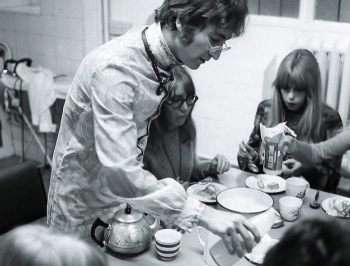
Pots of tea, milk bottles, sandwiches and Transcendental Meditation. Reagan Gavin Rasquinha sketches out their first meeting with the Maharishi. Whose teachings were brought to their notice by model Pattie Boyd, who was Harrison's wife at the time.
Bangor, Wales. August 26, 1967. The air felt heavy with incense, cigarette smoke, and the lingering hum of last night’s acid. The Beatles had released Sgt. Pepper’s Lonely Hearts Club Band only a few months earlier, sending shockwaves through music and culture, altering pop forever, and shifting the collective consciousness of an entire generation. Now they found themselves in the quiet halls of Bangor University, a serene place that seemed worlds away from the whirlwind of Beatlemania. They moved through the corridors like wandering mystics, their fame pressing against the walls like static electricity. Henry Grossman, the soft-spoken photographer, captured every detail with a quiet reverence, producing a series of images that felt less like journalism and more like sacred relics. There were bottles of milk on the table, cups of tea balanced in famous hands, laughter echoing through sunlit rooms as if history itself had decided to take a breath.
At the center of this intimate tableau stood Pattie Boyd, luminous and untouchable, her beauty almost spectral in its glow. She was George Harrison’s muse, a figure of inspiration who would later leave her mark on Eric Clapton’s life as well, and she represented an aesthetic shift that defined the late sixties. Around her moved Jenny Boyd, John Lennon with Cynthia by his side, Jane Asher poised with quiet elegance, Paul McCartney with his boyish calm, and Ringo Starr radiating his usual warmth. Together they formed a constellation of talent, influence, and myth, and yet here they were, drinking tea in Wales as if the universe had paused its spinning.
The contrast was striking. This quiet Welsh town, wrapped in rolling hills and mist, became a temporary stage for a cultural revolution. The Beatles had just turned the world inside out with their music, and yet these photographs showed them stripped of glamour, existing in a moment of stillness. Grossman’s lens did not dramatize them, it humanized them, and in doing so, he preserved the tension between celebrity and reality. The photographs became time capsules, reminders that even icons need breakfast, that even the architects of the psychedelic era craved simplicity amid chaos.
This gathering symbolized a turning point, a rare breath of calm in a decade spinning at full tilt on creativity, experimentation, and mind-bending substances. The summer of 1967 was still vibrating with the energy of the Summer of Love, and yet in Bangor, there was a quiet magic, a kind of surreal stillness that mirrored the cultural shift taking place. These were not just pictures of musicians; they were portraits of mythic figures caught between worlds, between fame and normalcy, between art and existence itself. The photographs remain a testament to that balance, a moment where rock royalty met domestic tranquility, a fusion of psychedelia and teacups, immortalized forever.
By Reagan Gavin Rasquinha
Reagan Gavin Rasquinha is a writer who moves between high culture and backroom blues, tracing the quiet revolutions that shape what we see, feel and hear.
