
08th May, 2026
 13th April, 2026
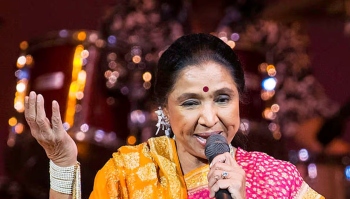
Asha Bhosle passed away on Sunday 12th April at the age of 92. And with her, something far greater than a life comes to a close. An entire era of Hindi film music, one that shaped how India felt, loved, and hummed.
For the longest time, Asha Bhosle lived in the shadow of her elder sister, Lata Mangeshkar. In an industry that often-had room for only one “definitive” female voice, Asha was the other one. The versatile one, the experimental one, sometimes, the overlooked one. But history has a way of correcting such hierarchies. And when it did, it did so gloriously.
The turning point came with O. P. Nayyar, who saw in her something others hadn’t fully tapped into - a certain playfulness, a certain rhythm, a voice that could swing. When he made her sing for Vyjayanthimala in Naya Daur, she wasn’t just lending her voice, she was claiming the centre stage. And then gems like Chain Se Humko Kabhi (‘Pran Jaaye Par Vachan Na Jaaye’) and Yahi Woh Jagah Hai (‘Ye Raat Phir Na Aayegi’) among several other great songs composed by O.P. Nayyar gave her a new identity.
Then came R. D. Burman—Pancham. A collaborator, a soulmate, and eventually her husband. Together, they didn’t just make songs; they redefined what Hindi film music could sound like. Piya Tu Ab Toh Aaja (‘Teesri Manzil’), Dum Maaro Dum (‘Hare Rama Hare Krishna’), and Chura Liya Hai Tumne (‘Yaadon Ki Baraat’) made her the voice of a new, modern India. Playful, bold, a little rebellious. And yet, the samePancham could turn her inward and fragile with Mera Kuch Saamaan (‘Ijaazat’) or Do Lafzon Ki Hai (‘The Great Gambler’). Few singers have travelled that emotional distance so effortlessly.
Her ghazal singing was another world altogether. Under Khayyam, in Umrao Jaan, she delivered songs that felt like they were steeped in silence and longing. Later, the album ‘Dil Padosi Hai’, with Gulzar and Pancham, showed us how intimate and literary, her voice could become. There was tehzeeb in her singing - grace, restraint, and a deep understanding of emotions.
Even time couldn’t contain her. When A. R. Rahman came along, he gave her voice a new canvas. Tanha Tanha (‘Rangeela’) sounded youthful without trying, and Radha Kaise Na Jale (‘Lagaan’) brought back a classical lilt with a fresh sparkle. Reinvention came naturally to her.
And now, with her gone, a chapter truly ends. Mohammed Rafi, Mukesh, Talat Mahmood, Manna Dey, Lata Mangeshkar - they all left over time. Asha Bhosle was the last living bridge to that golden age. And now, the bridge is gone. What remains are the songsand what songs they are.
I had the rare privilege of seeing her live at the Coca Cola Arena, Dubai in 2024. At 91, she stood on stage for nearly an hour and a half belting hits old and new with the fervour of a 20-yr old. Effortless, playful, ageless. At one point, she even danced a little while performing a contemporary number, smiling like someone who had never stopped enjoying music. It didn’t feel like watching a legend. It felt like watching music itself, refusing to grow old.
As we say goodbye, her voice lingers somewhere in memory, gently reminding us:
“Mera kuch saamaan tumhare paas pada hai…”
And that’s what it is. She has left parts of herself with all of us.
By Meraj Hasan
Meraj Hasan ‘meem’ is a Dubai based business and marketing consultant, poet and a music journalist. He also has a wide range of vinyl in his collection ranging from jazz, blues, classical, rock, pop and old Hindi film albums. Meraj's first book of poems, ‘Khyaalon Ki Tapri’ was an instant bestseller and he has just released his second book of poems, 'Boondon Si Baatein'.

