
04th October, 2026
 03rd October, 2026
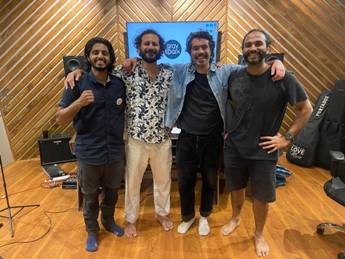
Singer-songwriter and guitarist Bhrigu Sahni releases the official music video for Azaadi, a guitar-driven rock song about freedom and resistance with his band Bhrigu and the Jaanemans.
The band released their first single because they feel a sense of hope in the current political context. The multiple protests over the last few months have shown that the present generation yearns for accountability. Each line in the song relates to the protests:“Unche hai pahaad, par hum chote, phir bhi hum chale…sabke liye” which means that while individually we are very small in the political context – but the collective strength of the people is high and we walk together for everyone.
Bhrigu wrote this song when he felt a wave of creative energy on his 37th birthday. “I felt elevated and connected to a higher part of myself. A sense of freedom felt accessible, and I felt this is how I want to feel and where I want to be. I remember writing this line. Azaadi hai in hawaaon mai, bhoolna mat yeh pal hazaaron hai ”- know that freedom is in the air and that you can access it, anytime”.
Too often we become stuck in our incessant thought patterns. But when you break out of that, you realise that you can tap into that peace at any given moment.
For Sahni, building a band began with a longtime quest: finding the right people to make music with. He says he got lucky finding this group of people right in his hometown of Pune, where a mix of old friends and serendipitous new connections came together to form the core of his live project, Bhrigu and the Jaanemans.
Multi-instrumentalist Jayesh Malani adds expansive texture with his work on keys, piano, guitar, and saxophone. Drummer Varun Venkit, a longtime friend, anchors the group with an old-school rock-and-roll sensibility. Bassist Shreyas Kadkol, originally a fan of Sahni’s music, rounds out the lineup with his melodic, groove-forward approach. They are the Jaanemans, a name that Bhrigu believes reflects an Indian identity and a certain affinity that they feel for each other.
Sahni spent a decade studying music and performing in the US. After he moved back to India, he felt the need to reconnect with his native language. He started reading works by his grandfather Bhisham Sahni alongside Urdu poetry and reading old comics like Chacha Chaudhary, over a period of several months, which helped him get better at the language.
This training helped him build the facility to write meaningful lyrics in his native tongue.
Sahni also referenced subliminal influences in his music by his grandfather and granduncle. His grand uncle Balraj Sahni, found his affinity and love for acting through his initial work with IPTA. Founded in the 1940s, IPTA was a radical cultural movement that took art out of elite auditoriums and onto the streets to wake up the masses. IPTA’s main theatre plays focused on social issues such as the plight of farmers and spreading secularist values in post-partition India. Similarly, his late grandfather, Bhisham Sahni, wrote the famous novel Tamas, which dissected the intense struggles of Partition and communalism. Bhrigu Sahni feels he has inherited these family values, which dictate that art must engage directly with the socio-political crises of its time and reflect the struggles of ordinary citizens.
Rock music has always been a form of anti-establishment. From The Who’s My Generation to Jimi Hendrixs’ Star Spangled Banner. In Azaadi, the raw electric guitar echoes feelings of freedom and rebellion. In the music video, the literal act of musicians playing their instruments can be seen as a visible form of protest.
Azaadi, written in Hindi, reflects Sahni’s growing interest in using his mother tongue to connect with deeper ideas and emotions.
Azaadi channels the same call to unity and to fight for one’s individual right and collective freedom. The lyrics mirror the demands of current Indian student and youth protests: freedom from authoritarianism, unaccountability and institutional bias.
