
07th March, 2026
 03rd September, 2025
A vinyl-first review of Gorillaz – Plastic Beach by Reagan Gavin Rasquinha on double heavyweight vinyl, written for an audience that knows why vinyl matters, who understands nuance, and who listens not casually but with intent…
Introduction: Vinyl as a Medium for Plastic Beach
When one places the needle on the heavyweight vinyl pressing of ‘Plastic Beach’, the experience is not simply about replaying a digital file in another format. It is about surrendering to the physical, analog ritual that frames the album in a different light. Gorillaz, as a project, has always been about layers. Damon Albarn builds a world that is animated yet lived in, ironic yet earnest, synthetic yet deeply human. On heavyweight vinyl, this duality reveals itself in ways that streaming or CD cannot quite capture. The subtle bloom of bass frequencies, the warmth of Albarn’s vocal timbre, the three-dimensional staging of orchestral passages, and the grit of certain percussion textures all land with a presence that requires the listener to stop multitasking and simply listen.
‘Plastic Beach’ was released in 2010, an era when vinyl had not yet returned as the dominant collector’s medium it has since become. Yet this double album, spread across two 180-gram records, seems to anticipate the resurgence. Listening to it now on vinyl feels less like nostalgia and more like restoration of intent. The sequencing makes sense as sides. The pacing of the flips feels considered. The sound design benefits from analog space. This is an album that thrives in its vinyl form.
Artwork and Packaging
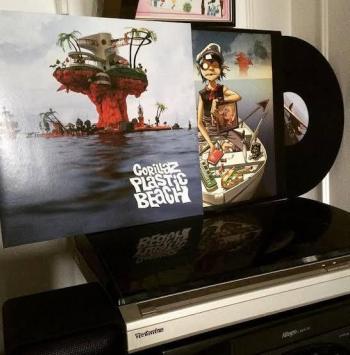
Jamie Hewlett’s artwork has always been central to Gorillaz, but with ‘Plastic Beach’, the vinyl presentation turns it into an immersive gallery. The gatefold design presents the fictional island rising from the sea, a collage of synthetic detritus forming a strangely beautiful monument. On twelve-inch format, the cover is neither ornamental nor secondary. It dominates your vision while the record spins, serving as a reminder of the conceptual underpinning: beauty out of waste, utopia made of plastic.
The double album gatefold allows for a fuller appreciation of Hewlett’s detailing. Colors are rich, deep, and painterly. The oranges and purples against the ocean blues glow differently under light compared to digital images. Inner sleeves carry thematic continuity, with character designs and fragments of the Plastic Beach world. Handling the vinyl itself becomes part of the experience. The weight of the 180-gram discs reinforces that sense of permanence and investment. This is not disposable music. It is something built to last, physically and sonically.
Side A
Orchestral Intro (feat. Sinfonia ViVA)
Opening with an orchestral overture, the vinyl playback presents strings with a rounded resonance. The inner detail of bow against string has air around it, a slight decay that digital compresses too tightly. This sets the tone immediately. It is not a cartoon gimmick, but an ambitious piece of arrangement, spatially wide and emotionally serious.
Welcome to the World of the Plastic Beach (feat. Snoop Dogg and Hypnotic Brass Ensemble)
Snoop Dogg’s voice rides on a deep, elastic groove. On vinyl, his vocal feels weighty, centered, commanding. The brass interjections cut with analog warmth, not brash treble. The groove plays with the stereo field in a way that feels alive through speakers. Albarn’s vision of a decadent yet corroded paradise finds its sonic emblem here.
White Flag (feat. Kano and Bashy with the National Orchestra for Arabic Music)
The Arabic orchestration glides with astonishing texture on vinyl. The reed instruments and percussion are etched clearly, not flattened. When the beat drops, Kano and Bashy’s verses punch through with rhythmic urgency. The contrast between classical instrumentation and grime flow feels more pronounced in this analog space, where frequencies are less congested.
Rhinestone Eyes
One of the most vinyl-friendly tracks on the record. The synth arpeggios swirl with motion, the bass sits deep but not bloated, and Albarn’s weary delivery feels intimate. There is a slight analog haze that makes the track even more hypnotic. The song’s theme of false glitter masking decay becomes almost tactile in this medium.
Side B
Stylo (feat. Mos Def and Bobby Womack)
Bobby Womack’s impassioned vocal bursts through the mix with raw human presence. On digital, it can feel overdriven, but on vinyl, it breathes. Mos Def’s verses hover and dart around the groove. The bassline here is particularly rewarding on heavyweight vinyl, resonant and clean, with no harsh clipping. The interplay between electronic pulse and soul vocal is monumental.
Superfast Jellyfish (feat. De La Soul and Gruff Rhys)
A track loaded with samples and comedic energy, yet on vinyl, the layers do not collapse. The samples have body, the drums have punch, and De La Soul’s vocal cadences are sharp. The silliness becomes subversive when given this level of fidelity.
Empire Ants (feat. Little Dragon)
The vinyl’s most transcendent moment. Yukimi Nagano’s voice enters like glass, fragile yet luminous. The song’s shift from minimalist ballad to electronic rush feels cinematic on wax. The sub-bass in the second half blooms naturally rather than distorting. The stereo imaging is wide, almost oceanic, giving a sense of the Plastic Beach world expanding in real time.
Glitter Freeze (feat. Mark E Smith)
The raw, motorik pulse here is relentless. Vinyl playback emphasizes the physicality of the beat, almost mechanical. Mark E Smith’s declamations cut through as abrasive texture. It is claustrophobic in digital but expansive in vinyl’s staging.
Side C
Some Kind of Nature (feat. Lou Reed)
Lou Reed’s dry, sardonic delivery feels hauntingly present, as if standing in the room. The vinyl medium flatters his voice, catching the grain in his tone. The arrangement, spare yet quirky, finds warmth in analog playback.
On Melancholy Hill
Perhaps the most beloved Gorillaz song, and on vinyl it is pristine. Albarn’s vocal floats with gentle melancholy. The synth lines shimmer without harshness. The track’s bittersweet mood becomes heightened by the ritual of listening on record, needle tracing sadness in circular form.
Broken
This track thrives on vinyl’s ability to render low-end with authority. The bass pulses beneath the mix like a heartbeat. Albarn’s processed vocal gains depth. The textures feel less synthetic and more organic, as though the brokenness is embodied sonically.
Sweepstakes (feat. Mos Def and Hypnotic Brass Ensemble)
On vinyl, this sprawling piece feels alive, dynamic, and bold. The brass carries a gritty bite, Mos Def’s performance dances unpredictably, and the groove builds with relentless force. It fills a room in a way that digital cannot replicate.
Side D
Plastic Beach (feat. Mick Jones and Paul Simonon)
The presence of the Clash alumni grounds this track with a lineage of rebellious sound. The bass has clarity, the guitar texture has bite, and Albarn’s vocal floats with eerie detachment. The title track is not bombastic, but its subtle layering finds clarity here.
To Binge (feat. Little Dragon)
Yukimi Nagano once again shines. Her voice is crystalline, and the duet with Albarn feels intimate, as if recorded in a smaller space. On vinyl, the warmth in their interplay is heightened.
Cloud of Unknowing (feat. Bobby Womack and Sinfonia ViVA)
This is the emotional climax of the album. Womack’s soul-rending vocal, framed by orchestral grandeur, is majestic. Vinyl’s ability to present scale while maintaining warmth is crucial here. The track is overwhelming in its beauty.
Pirate Jet
Closing the album, Albarn’s almost throwaway delivery finds irony heightened by vinyl’s physical act of conclusion. As the record spins toward the label, the track’s brevity feels intentional, like a wink before silence.
Technical Observations
The pressing itself carries minimal surface noise, impressive for a complex production like this. The heavyweight vinyl ensures stability, tracking bass frequencies without distortion. The stereo imaging feels wide, detailed, and immersive. Unlike digital playback, where compression often narrows dynamics, here the orchestral swells breathe, the bass flows, and the vocals have distinct character. The sequencing across four sides allows each cluster of tracks space to live, avoiding inner groove distortion issues that might plague a single LP.
Conclusion
‘Plastic Beach’ on heavyweight vinyl is not simply a replay of Albarn’s ambitious 2010 opus. It is the definitive way to inhabit the Plastic Beach universe. The analog warmth enhances the humanity within the synthetic, the ritual of flipping sides mirrors the album’s structural movements, and the artwork in twelve-inch scale reinforces its conceptual richness. For a listener who knows vinyl, who values the medium not as nostalgia but as necessity, this pressing is more than an artifact. It is the complete Plastic Beach experience.
Side Note: Something Extra
What makes ‘Plastic Beach’ fascinating is that Albarn originally intended it to be even larger in scope, with unreleased collaborations ranging from Barry Gibb to The Horrors. The sessions reportedly stretched into dozens of tracks, but the vinyl format demanded focus. What you hear on these two discs is not just what Albarn recorded, but what was curated to fit the physical and conceptual parameters of vinyl. This limitation, paradoxically, strengthened the album. The discipline of sequencing across four sides gave the work coherence, ensuring that Plastic Beach exists not as a bloated archive but as a perfectly sculpted island.
By Reagan Gavin Rasquinha
Reagan Gavin Rasquinha is a writer who moves between high culture and backroom blues, tracing the quiet revolutions that shape what we see, feel and hear.

