
07th March, 2026
 01st November, 2025
A vinyl-first review of Blur’s ‘Think Tank’ by Reagan Gavin Rasquinha. Written for people who buy new vinyl and appreciate savoring sounds in different formats.
When you play ‘Think Tank’ on vinyl, it doesn’t feel like an artifact of the early 2000s. It feels like a time capsule cracked open just now, warm, imperfect, and human. The sound production is top notch.
Released in 2003, Think Tank marked Blur’s first and only full-length without Graham Coxon, who appears on just one track. It was the sound of Damon Albarn reorienting himself toward the world, pushing past the insular Britpop identity into something more global and emotionally diffuse. On heavyweight vinyl, the album takes on an even deeper texture. The bass has a natural presence that the CD never captured, and the percussion, often hand-played and looped, breathes with a sense of space that reminds you this was recorded by people, not just Pro Tools.
Side 1 (A)
The album’s opener, Ambulance, unfurls slowly, a gentle drone giving way to soft percussion and Albarn’s fragile voice. On vinyl, the low-end hum becomes a kind of pulse, the sound of machinery idling beneath emotion. The cymbals spread wider, the delay on Albarn’s vocal blooms longer. The track feels simultaneously intimate and detached, a perfect entry into the fractured warmth of this record. Out of Time, the album’s best-known single, glows on wax. The Moroccan percussion and acoustic guitar feel tactile, grounded. The song’s melancholy melody hangs over a rhythm that is more physical here, less polite than on streaming versions. Albarn’s delivery is resigned but hopeful, and the analog playback allows his voice to sit forward, not glossy but textured, as if the microphone itself were sighing.
Side 2 (B)
Crazy Beat is Fatboy Slim's production. Wild, distorted, slightly obnoxious. Gains extra grit on vinyl. The groove thickens, and the guitar stabs sound rougher, as if the stylus itself is struggling to contain the chaos. It is not the most subtle track, but in this format, it earns its place as a moment of manic release before the album retreats into darker corners. Good Song and On the Way to the Club carry that sense of late-night reflection that runs through the record. On vinyl, you hear more of the small things: the finger noise on the strings, the air in the vocal booth, the hesitant spaces between beats. These are the details that remind you why vinyl still matters.
Side 3 (C)
The second side deepens the album’s mood. Brothers and Sisters has a dubby swagger that vinyl flatters beautifully. The bassline has real movement; you can almost feel the cone of the speaker working. Caravan shimmers in this medium, the quiet percussion and ambient textures enveloping the listener in a way digital can’t quite replicate. Albarn’s voice sounds slightly behind the beat, more human than stylized. We’ve Got a File on You, the only track with Coxon, snaps like a live wire: short and punk-ish. The vinyl format lets it hit with raw energy before the record drifts back into its dreamier zones.
When Sweet Song arrives, it feels like a small emotional clearing. Albarn’s voice is cracked and direct, the piano chords resonating with warmth. The vinyl’s natural decay adds something almost tender here, the sound of a room rather than a studio.
Side 4 (D)
Jets, an experimental jam built on heavy bass and layered noise, is where the analog depth really pays off. The sonic sprawl can overwhelm on digital playback, but on vinyl it finds its dimension, with the low frequencies deep, testing your equipment..
The album closes with Battery in Your Leg and Me, White Noise, two very different epilogues. 'Battery' features Coxon and sounds like a farewell. The piano line feels suspended, the vocal unsure but sincere. On vinyl, the room tone wraps around the melody like fog. Me, White Noise, on the hidden final groove, bursts through like a secret broadcast from another frequency: abrasive, political, ghostly. It’s an ending that only makes sense if you’ve spent the previous hour immersed, not skipping tracks.
Sonic reflections:
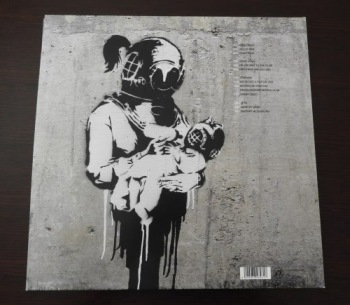
The physical presentation of ‘Think Tank’ on vinyl complements its content. The Banksy-designed cover, stark red with the anonymous couple in gas masks, feels weightier and more ominous at twelve-inch scale. The gatefold inner art expands on that sense of postmodern disquiet like murals, street iconography, fragments of travel and distance. Holding the record reinforces what the album itself suggests: this is about displacement, identity, and searching for connection in an uncertain world.
Technically, this pressing is excellent. The surface noise is minimal, the stereo image wide but stable. There is breathing room between the grooves, giving each track enough space to unfold without inner groove distortion. The mastering respects dynamic range, allowing the quieter songs to whisper and the louder ones to roar without compression fatigue. It’s the kind of pressing that rewards good speakers and patience.
Listening to ‘Think Tank’ on vinyl today, it feels like an album both unfinished and fully realized, a farewell and a new beginning. What was once seen as Blur’s fragmented, uncertain end now sounds like the point where Albarn began to build the next chapter from Gorillaz to The Good, the Bad & the Queen and beyond. In that sense, this vinyl pressing isn’t just a collector’s item. It’s a document of transition, preserved in grooves that still speak, twenty years later, with quiet conviction and strange beauty.
Reviewed by Reagan Gavin Rasquinha
Reagan Gavin Rasquinha is a writer who moves between high culture and backroom blues, tracing the quiet revolutions that shape what we see, feel and hear.

