
23rd April, 2026
 02nd January, 2026
‘Breakfast in America’ is one of those records fans think they already understand. That’s precisely why a vinyl-specific review works now, finds Reagan Gavin Rasquinha.
Vinyl exposes the record’s engineering. This album is a masterclass in late-70s studio precision. On vinyl, the separation between Davies’ Wurlitzer, Hodgson’s layered harmonies, and Dougie Thomson’s bass becomes tactile.
Streaming flattens that relationship. Vinyl restores intent. This is not a track by track blow by blow account because that reads sometimes like a grocery list and can get a bit lazy. Everything that I am not. So this tells you about some and the rest is the road for you to travel on. It also reveals how carefully balanced this record really is, how little excess there is once you strip away decades of radio familiarity.
The album sits at a crossroads. Soft rock, prog discipline, pop ambition, and radio cynicism collide here. This is not just a collection of singalong hits built around The Logical Song. It is a band quietly cashing in its own artistic innocence, aware that accessibility and ambition were about to pull them apart. That tension is audible when the record is allowed to breathe.
The album has aged better than its reputation. The irony, anxiety, and transatlantic unease land harder in 2025 than they did in 1979. America as idea versus America as product is embedded into the grooves, not shouted from the lyrics. On vinyl, those contradictions are harder to ignore because the music is less compressed, less hurried, and more revealing of its internal balances.
On vinyl, the album reveals itself as a precision-engineered pop record disguised as soft rock. It also plays like a farewell document, the last moment before Supertramp fractures into separate creative directions. And it functions as satire that sounds warm but cuts cold, never announcing its intent outright.
Listening to a clean pressing immediately establishes why this album rewards the format. There is warmth, but it is not the forgiving warmth of blur or saturation. It is a controlled warmth that allows clarity to sit comfortably inside it. The stereo image opens wide without becoming showy. On Goodbye Stranger, the left and right placement of electric piano and backing vocals creates lateral movement that feels deliberate rather than decorative. Instruments occupy defined spaces and remain anchored there. Nothing crowds the centre unless it is meant to.
Take the Long Way Home is where low-end control becomes obvious. Dougie Thomson’s bass does not thump or bloom. It flexes. Each note is placed, released, and allowed to decay naturally. Vinyl restores the discipline of those lines and makes clear how much restraint went into making them feel this relaxed. The album’s surface noise tolerance is surprisingly high. The arrangements are dense enough to mask minor imperfections but transparent enough to punish careless playback. Clean vinyl does not merely improve the sound here.
Instrumentation functions as character throughout. The electric piano acts as the narrator. Davies’ Wurlitzer is not simply accompaniment but a framing device, setting emotional temperature and often undercutting the lyrics by sounding warmer than the words deserve. On vinyl, the transient attack of the keys and the slight grit beneath them become audible, giving the instrument a human presence that digital formats tend to smooth away.
The saxophone appears sparingly and never as indulgence. When it enters, it feels like a character stepping briefly into the room, making a point, and leaving. There is no excess phrasing and no jazz flourish for its own sake. Harmonies function as emotional camouflage. Hodgson’s stacked vocals often soften lines that are, on closer listening, deeply uneasy. Vinyl allows those harmonies to sit inside the mix rather than floating above it, reinforcing the sense that comfort here is constructed, not natural.
Lyrically, The Logical Song sounds clinical rather than sentimental on vinyl. Its theme of infantilisation is reinforced by the tightness of the arrangement. There is no sonic indulgence to cushion the message. The precision becomes part of the critique. This is not nostalgia...
The title track Breakfast in America plays escapism against disillusion with a lightness that borders on evasive. On vinyl, the contrast between upbeat delivery and underlying cynicism sharpens. The song does not celebrate fantasy so much as expose its cost. The record never lectures. It presents the contradiction and leaves the listener to sit with it.
Goodbye Stranger deals in performance versus authenticity. Vocal confidence masks a deeper instability. Hearing it on vinyl, where the harmonies blend rather than dominate, makes the performance feel intentional, almost strategic. The song knows it is charming you, and that awareness is part of its unease.
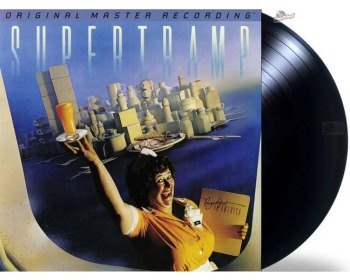
At twelve inches, the album artwork works better. The satire reads clearer. The artificial skyline, the waitress as icon, the deliberate cheapness of the fantasy all register more forcefully when given physical scale. The inner sleeve typography and visual cues anchor the album firmly in its era without trapping it there. This is context, not retro dressing.
Dropping the needle restores the album’s theatrical pacing. Side breaks matter. The flow is intentional. You hear the band managing attention, tension, and release with confidence. Streaming disrupts that architecture. Vinyl restores it.
I am not here to tell you what this album is. Most of you reading this already know the popular hits and likely encountered them as part of your growing years. This is for the generation that has not, and for those who have and are willing to return to it without assumption. This is lean audiophile listening meeting cultural critique. The authority comes from selection, from listening closely, and from allowing the record to reveal its intelligence without ornament or sermonizing. At the end of the day, this is still music meant to be played, lived with, and enjoyed.
By Reagan Gavin Rasquinha
Reagan Gavin Rasquinha is a writer who moves between high culture and backroom blues, tracing the quiet revolutions that shape what we see, feel and hear.
