
23rd April, 2026
 01st April, 2026
Having barely got over the shock of John Bonham's untimely passing in 25th September, 1980, the remainder of the group gathered their wits and energies to put out this collection, a grab bag that felt fitting at the time and still feels like it could have been a double set or a luxurious box set. But today, fans still see the nostalgia in this.
I came to Led Zeppelin late and sideways, the way most people come to things that eventually matter enormously to them. My first exposure was at a summer club in a church compound in South Bombay (as then called and still is, in spirit and soul) in the early nineties, where older boys played music on loudspeakers for kids who had barely hit puberty. What filtered through included Rock and Roll, which struck me as perfectly ordinary, and Out on the Tiles, which I did not know how to process at the time. Led Zeppelin registered as ‘meh’, not revelation, and I moved on.
Years later, at Rhythm House in Kala Ghoda, I stood in front of a rack of cassettes and CDs and noticed an album with an olive drab cover, the word CODA printed on it in plain lettering, surrounded by what appeared to be an enormous quantity of unsold stock. The album cover looked stark yet modern at the same time. Like a bootleg or a deliberate call to focus on the music rather than celebratory artwork. That abundance suggested significance, so I picked it up, read the track listing, recognised nothing, and put it back. That was 1996, give or take.
The actual discovery happened in 2014, in a first class cabin on an Emirates A380-800 somewhere over the Atlantic Ocean, champagne flute or Jack Daniels (more Jimmy Page’s style) in hand, reading Stephen Davis's ‘Hammer of the Gods’while ‘Physical Graffiti’moved through my headphones felt appropriate for that altitude and that level of indulgence. I flew Qatar Airways first class another time on a Bombay to Houston routing and the experience was no less extraordinary. That was the moment Led Zeppelin stopped being a name and became an experience. The bravado, the swagger, the absolute refusal to be modest about any of it, the music demanded a matching context, and a palace in the sky provided it. After those flights, I went back to everything. Including CODA.
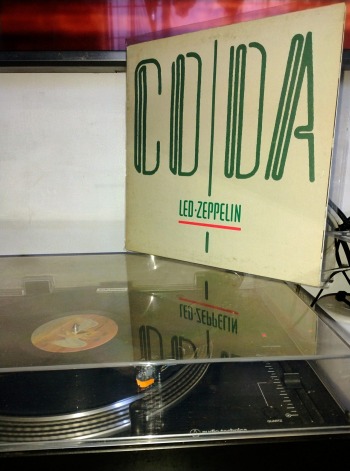
Putting the fresh vinyl pressing of ‘CODA’ on a turntable today is an exercise in appreciating a document rather than a designed album, and once you accept that distinction, it becomes considerably more interesting. This was never a statement of artistic intent. It was Robert Plant, Jimmy Page and John Paul Jones deciding that what remained of their recorded archive deserved a dignified release rather than a vault, and they were right to do so.
We're Gonna Groove, which opens the record, is a live recording from 1970 with overdubs added later, and it announces immediately that this collection will not be polished or uniform. What it will be is honest. The track has a rawness that studio recordings from the same era sometimes smoothed over, and Page's guitar sits high in the mix with a ferocity that the rest of the album occasionally matches but never quite surpasses.
Bonzo's Montreux is the piece that stops conversations. John Bonham recorded it in 1976 with electronic treatments applied by Page, and it functions simultaneously as a technical exhibition and an elegy. Listening to it now, knowing what came after, the drums feel almost unbearably present. There is nothing spectral about the performance. It is physical and alive and completely sure of itself, which makes the circumstances of this album's existence sit heavily during the four minutes it runs.
Wearing and Tearing, recorded during the 1978 Knebworth sessions, is the track that raises the most obvious question about the band's direction had Bonham survived. It is fast, aggressive and direct in a way that suggests Zeppelin was capable of moving somewhere new without abandoning the architecture that made them. The fact that it ended up here rather than on In Through the Out Door is one of the more interesting accidents of their discography.
Walter's Walk and Ozone Baby, also from Knebworth, fill the record's middle section with the kind of propulsive, uncomplicated rock that the band could produce almost reflexively by that point. They are not minor works dressed up as major ones. They are exactly what they appear to be, which is Zeppelin operating at a level most bands spent careers trying to approach. It was what it was. Page had to chuck an album together to fulfill the contract with Atlantic so he took a quick look in the spares dept. There are some real gems there. Poor Tom’s worth the admission price alone. White writing this I read that old-time fans and new ones too, of straight-ahead rock prefer this to Out Door.
‘CODA’ does not replace any of the canonical records in the catalogue. It was never meant to. What it does is extend the conversation, offering evidence that the band's final years were more generative than the circumstances of their ending allowed people to acknowledge at the time. The fresh pressing sounds cleaner than the original release deserved, and that clarity does the material genuine service.
By Reagan Gavin Rasquinha
Reagan Gavin Rasquinha is a writer who moves between high culture and backroom blues, tracing the quiet revolutions that shape what we see, feel and hear.
The writer can be contacted at reagangavin@gmail.com

