
26th September, 2026
 01st June, 2026
The Beatles were always experimental in the studio. Always pushing boundaries, but it was pretty early on when they actually started seeing what was sonically possible beyond the norm. The Beatles' ‘Sgt. Pepper's Lonely Hearts Club Band’ was officially released in the UK on 26th May, 1967, ahead of its scheduled 1st June date, and in the US on 1st June.
So what does one possibly say about an album which has been written about from here to eternity? Here, I touch up on it in as non-technical a way as possible, the little surprises beyond the music…
Firstly, this is one heck of an intimidating album to write anything about. It’s one of those. One of those monologues that you approach not knowing where to begin and where to end so you don’t even try you just try and pick one angle… That’s the best that can be done because they literally is no beginning and no end to the body of work that these four guys did beyond what was even recorded. This one has been analyzed in meaning, from conception to execution, front cover to back cover, a cultural phenomenon and literally everything in between I mean, you could throw an entire dictionary at it and a thesaurus as well and it wouldn’t be enough. That’s precisely when another dissection will only become tautology so I decided to instead merely look at the technicals. Without getting into instruction manual territory. And why technical? Because before the Beatles hit it big, they were essentially a black leather-wearing almost punk/GarageBand in Hamburg’s seedy and dangerous red light district (Reeperbahn) before being tidied up for about three years before letting the music really breathe.
I got frustrated with that and started getting curious about using the tools of their trade in different ways. Their first three albums were rushed jobs. The tracks were immediate and fresh and most of them were written on demand some of them written even before they became big. It was about chicks. That never gets old. But then with a secure global fan base, they decided to consolidate… And breathe. Let the music breathe.
The ‘Help!’ OST happened, followed by ‘Rubber Soul’, ‘Revolver’, ‘Pepper’ and everything else they did after that. These tracks have been dissected, meanings both real, deduced and induced from various altered states of consciousness in various types, degrees and dimensions extrapolated. So essentially they were using the studio itself as an organic instrument which is actually a thrilling concept and a lot of groups nowadays who take their music seriously as an art form, do that as well.
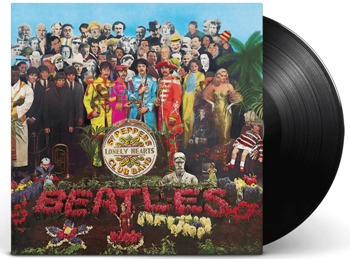
The cover alone could hold you for an hour before you think about pressing play. Sixty-odd famous faces assembled in a Victorian garden party of the imagination, the four lads dressed in Day-Glo military costumes that might have come off a Carnaby Street stage, surrounded by their own waxwork selves still wearing the matching suits they had long since stopped putting on. Peter Blake and Jann Haworth built it like a film set, Michael Cooper photographed it, and tucked inside was the first time any significant rock band had placed their lyrics directly in the listener’s hands, which meant the words were intended to be followed, which meant the record was asking for a different kind of attention altogether. But that’s another story. In an album full of stories.
Inside Studio Two at Abbey Road between November 1966 and April 1967, the technical conditions were, by any later standard, severely limited. EMI’s four-track Studer machines running at 15 inches per second were the recording foundation for the entire album. The team would fill all four tracks, reduce them to a single composite, free up three tracks again, and begin layering the next tier, a process called reduction mixing, which accumulates tape hiss and costs dynamic resolution with every pass between machines. The Beatles ran this cycle repeatedly across the album, committing each reduction permanently because there was no other method available for building the density of overdubs the arrangements required, and every orchestral pass, every sound effect, every additional texture had to be planned in full sequence before the tape rolled, because once a reduction was made, nothing could be retrieved from it.
Geoff Emerick was 20 years old and had not engineered a full album before ‘Revolver’. He spent these sessions systematically violating EMI’s own technical protocols. The house rules required microphones to maintain minimum distances from instruments, and he placed one inside the kick drum, which had not been done at Abbey Road before, producing a change in the sound of Ringo’s kit that is audible immediately in comparison to every prior Beatles record. The resonance head came off the bottom of the snare to kill the natural ring, a close-placed mic on the top produced a dry, contained impact rather than the open, airy sound of the earlier recordings, and the overall kit acquired a physical weight and presence it had not previously had. McCartney’s bass, whether the Rickenbacker 4001S strung with Rotosound flatwounds or the Fender Jazz Bass he was beginning to introduce into sessions, ran through a direct injection box bypassing the amplifier entirely, feeding straight into EMI’s REDD.51 console and then through heavy limiting and compression that pushed the low end to the front of the mix with a melodic density the earlier records had not approached.
Ken Townsend, the EMI staff engineer, invented Automatic Double Tracking midway through the sessions because Lennon complained persistently enough about manually double-tracking his vocals that Townsend sat down and built a machine to eliminate the process. A recorded vocal passes through a second tape machine whose capstan speed is continuously varied by a low-frequency oscillator, producing a slightly phase-shifted copy which, mixed with the original, creates the thickened and subtly unstable timbre audible on virtually every vocal across the album. The technique was adopted across the recording industry within a year of the record’s release, and its signature sound carries through most of what gets called the psychedelic era.
Vari-speed recording was deployed throughout to manipulate pitch and modify timbral character. The entire backing track of When I’m Sixty-Four was recorded slightly below standard playback speed, raising the pitch by roughly a semitone on playback and brightening McCartney’s voice above its natural register in a way that sits precisely with the song’s quality of willed nostalgia. The piano introduction to Lucy in the Sky with Diamonds was recorded at half speed, extending each note’s attack during the take so that at normal playback the keystrokes arrive with a compressed, slightly mechanical precision. Lennon’s lead vocal on the same song was also pitched up at playback, placing his voice fractionally above its natural range and contributing to the song’s sense of mild spatial dislocation.
George Harrison ran guitar signals through a Leslie 147 speaker cabinet on several tracks, a unit designed originally for Hammond organs, whose two rotating speakers produce a continuous pitch modulation as the sound alternates between them at speed. The effect on guitar produces a warbling, slightly woozy rotation that was not achievable through standard amplification, and it contributes substantially to the mid-range texture on multiple tracks alongside Emerick’s compressed drum sound and the treated keyboards.
For Being for the Benefit of Mr. Kite, Lennon wanted the recording to physically resemble a Victorian circus, to smell of sawdust in his description of what he was after. Martin took recordings of steam organ and calliope music, cut the tape into sections by hand, scattered the pieces across the floor, picked them up without selecting, and spliced them back together in the order they came to hand. The coherence of the finished texture comes entirely from the shared tonal range of the source material rather than from any intentional structure, and the method is precisely as described: scissors, tape spooled across a studio floor, and no plan beyond retrieval.
The 41-piece orchestra on A Day in the Life was given a single instruction, which was to start at the lowest note available on their instrument and arrive at the highest over approximately 24 bars, each player navigating independently without reference to any other player in the room. This was recorded four times and layered onto itself with varying equalization and level adjustments, making the final crescendo the product of four overlapping passes of 41 separate simultaneous improvisations. The closing E major chord was struck simultaneously on three pianos and a harmonium by five players, the studio faders held at maximum during the decay, the signal subjected to additional limiting to sustain the room noise audibly as the chord dissolved over 40 seconds rather than fading before the tape ran out.
By Reagan Gavin Rasquinha
Reagan Gavin Rasquinha is a writer who moves between high culture and backroom blues, tracing the quiet revolutions that shape what we see, feel and hear.
The writer can be contacted at reagangavin@gmail.com
