
10th November, 2026
 01st November, 2026
Fifty-five years ago this week, Duane Allman died riding his motorcycle through Macon, Georgia, and music lost someone who laid the foundations of Delta blues guitar, finds Reagan Gavin Rasquinha
He wasn't formally educated in music. He didn't come from money or from a tradition that prepared him for what he became. What he had was an ear, a work ethic that bordered on obsessive, and an instinct for the slide guitar so particular that even now, nobody who plays in his style is doing anything more than orbiting the original. He used a Coricidin medicine bottle as his slide, that small glass cylinder giving his playing a singing, keening quality that sat somewhere between a human voice and something older than words. On a good night, and the Fillmore East nights were good nights, he sounded like the blues had been compressed into a single man's fingers.
I first properly heard this album ‘At Fillmore East’ – Live album by The Allman Brothers Band, in 2013, about a day before I was going to see what remained of the Allman Brothers orbit live in Florida, which included Derek Trucks and Susan Tedeschi, and the whole sprawling blues circuit that feeds into Eric Clapton's Crossroads Guitar Festival. I put the needle down on Statesboro Blues and my mother walked in from the next room. She stood in the doorway and asked, "What is that? It sounds really good." I was surprised. She was never a rock listener. She wouldn't have known the Allman Brothers from any other name. But something in what was coming off the speakers caught her before I could even introduce her to it. That was her entire relationship with this record. She passed away in June 2016, and now every time I hear In Memory of Elizabeth Reed, I think of her standing in that doorway, already won over before she knew what she was listening to.
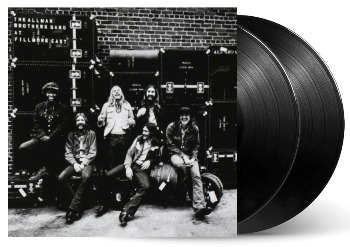
The record is ‘At Fillmore East’, a double album recorded over two nights at Bill Graham's legendary venue in New York City, 12th and 13th March, 1971. Produced by Tom Dowd, photographed by Jim Marshall, it is one of the few live albums in the rock canon that does not flatter the band so much as simply document them at their peak. What you hear are six musicians who had been playing together long enough to trust each other completely, and that trust opens up space that most bands never find.
Side One opens with Statesboro Blues, a Blind Willie McTell song that the Allmans had absorbed so thoroughly it no longer sounds like a cover. Duane's slide is front and centre, and the tone alone separates this from almost anything else being recorded at the time. Done Somebody Wrong follows with Gregg Allman handling the vocal with a laidback authority that made him such a perfect foil to his brother's intensity. Stormy Monday, the T-Bone Walker standard, closes the first side and gives Duane eight minutes to demonstrate why Eric Clapton once said that hearing him play changed the way he thought about the guitar.
The Clapton connection to Duane Allman is worth pausing on. Clapton was already established as one of the great guitar voices of his generation when he encountered Duane. The story goes that Clapton was playing somewhere and Duane was in the front row, watching him closely. They found their way into the studio afterward through producer Tom Dowd, during the sessions for Layla and Other Assorted Love Songs. You will find more about this encounter on reagangavin.substack.com about how they jammed through the night, the two of them, and by morning the dynamic had shifted. Clapton invited Duane onto the album, and the slide work on Layla itself is what gives that song its specific ache. Duane went on to join Derek and the Dominoes on several US tour dates, the only time in his career he played extended shows as a featured guest with another band. Clapton, who is not given to easy admiration of other guitarists, has spoken about Duane with a reverence he extends to very few people.
Side Two is essentially one track, You Don't Love Me, a Willie Cobbs song that runs just over nineteen minutes. It is the most purely improvisational piece on the album and the one that divides casual listeners from the converted. Dickey Betts takes extended soloing alongside Duane, and the interplay between the two guitars across those nineteen minutes is where the Allman Brothers' particular genius sits most visibly. Neither player is showing off. They are listening to each other and responding, and the whole thing breathes rather than sprawls.
Side Three begins with Hot 'Lanta, a band original with a tighter, funkier feel, Jai Johanny Johanson and Butch Trucks driving the rhythm section with a looseness that never loses the pocket. Then comes In Memory of Elizabeth Reed, a Dickey Betts composition running nearly thirteen minutes and the emotional centrepiece of the record. It moves through several distinct moods without announcing any of them. The melody is genuinely beautiful in a way that stopped a woman who had never heard the Allman Brothers in her life in a doorway, and made her ask what she was listening to.
Side Four is Whipping Post. Twenty-two minutes and forty seconds. Gregg Allman's vocal is extraordinary from the first line, and the whole band builds around him through a performance that starts somewhere in soul music and ends somewhere else entirely. Duane's slide enters at the right moment and doesn't leave until the song is done with you. It is the kind of performance that makes arguments about whether rock can be art feel slightly beside the point.
Duane Allman died on 29th October, 1971, a few months after these recordings were made and just a year after Layla was released. He was twenty-four. He swerved his motorcycle trying to avoid another vehicle and lost control. It was a death of complete randomness, no narrative, no warning. What it left behind was this record, the studio work, and a legacy of slide playing that every subsequent practitioner of the form has had to reckon with.
The double album gatefold sits in my collection with its Jim Marshall sleeve photograph, six young men in denim who look like they have no idea what they are about to become, and the orange Mercury label on the vinyl, and the whole thing still plays like it was recorded yesterday.
Release date: 6th July, 1971
Label: Capricorn Records.
Reviewed by Reagan Gavin Rasquinha
Reagan Gavin Rasquinha is a writer who moves between high culture and backroom blues, tracing the quiet revolutions that shape what we see, feel and hear.
The writer can be contacted at reagangavin@gmail.com

